

Integrated BESS, Wind, Solar and Data Center Project
Across Australia, large-scale renewable and digital infrastructure developments are increasingly being delivered as integrated precincts rather than standalone assets. These developments commonly combine utility-scale solar or wind generation, Battery Energy Storage Systems (BESS), high-voltage substations, data centres, and backup generation supported by diesel and other Dangerous Goods (DG).
While this integrated bess and renewable energy precincts improves energy resilience and grid stability, it introduces significant regulatory challenges and fire safety complexity. Planning authorities and emergency services no longer assess each asset independently. Instead, they evaluate cumulative hazard exposure, cross-asset escalation risk, and precinct-wide emergency response capability.
Risk and Safety Solutions Melbourne (RSSM) has been supporting developers, planners, and EPC contractors in navigating this evolving approval environment by delivering integrated hazard assessments aligned with Australian regulatory expectations and global best practice.
The Regulatory Intersection: Where Complexity Emerges
Regulators assess how these frameworks interact at a precinct scale, not how each asset complies in isolation. This regulatory overlap is where approval friction most often emerges.
Integrated bess and renewable energy developments simultaneously engage multiple regulatory and technical frameworks, including:
- State and federal based planning regulations
- Local council planning regulations
- Local authorities planning consent conditions
- AFAC - Large-Scale Lithium-Ion Battery Energy Storage System Incident Response Guideline. AFAC, Australia.
- Country Fire Authority - Alternative & Renewable Energy Facilities – Fire Safety Guidance. CFA, Victoria, Australia.
- For Victoria State, Fire Rescue Victoria - Fire Safety Guideline GL-55: Battery Energy Storage Systems (BESS).
- For New South Wales, Fire and Rescue NSW - Lithium-Ion Battery and BESS Fire Safety Position Statements / Technical Guidance. FRNSW, NSW.
In practice, the challenge is not compliance with a single framework, but alignment across multiple overlapping ones. When authorities assess projects from a precinct perspective, an asset may satisfy individual technical requirements but may still encounter approval issues if its risk profile is not coherently integrated into the broader regulatory context.
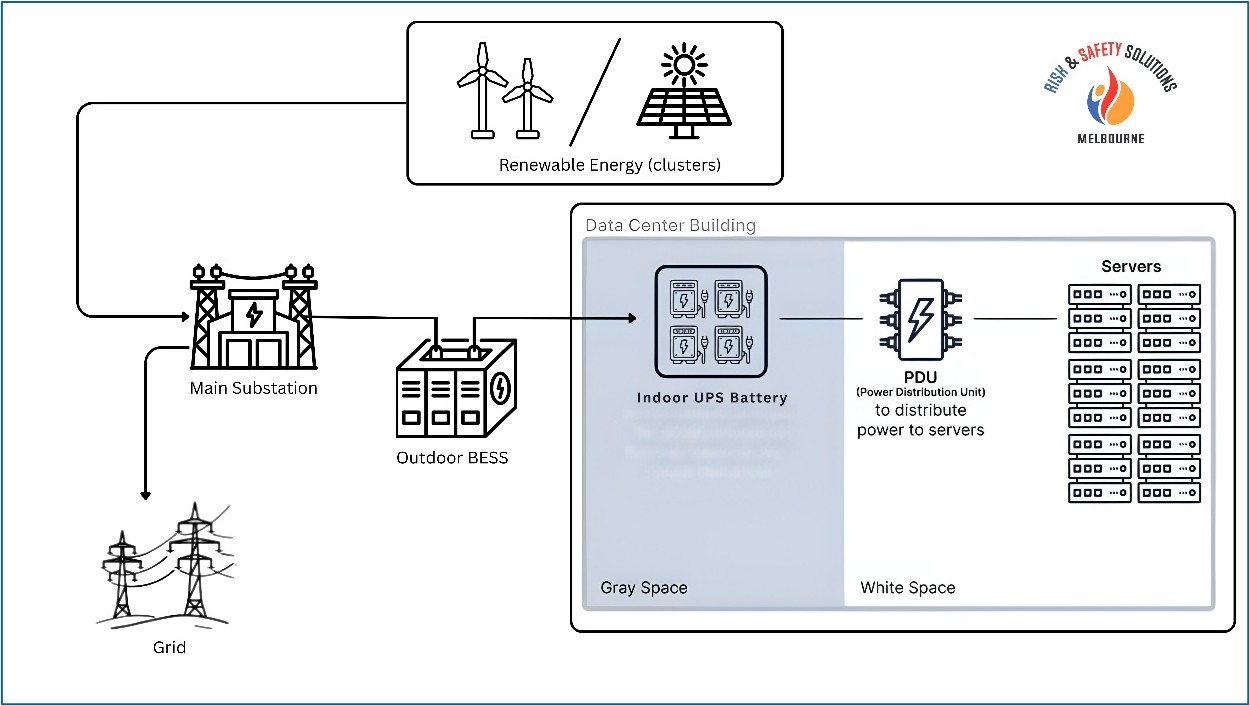
Four Critical Regulatory Challenges in Integrated Bess and Renewable Energy Developments
Cross-Asset Fire and Explosion Exposure
Planning authorities increasingly require demonstration that worst-case scenarios do not escalate across assets.
This typically involves:
- Thermal radiation modelling of transformer oil pool fires
- Thermal runaway propagation assessment for BESS
- Explosion overpressure analysis from gas venting
- Radiant heat impact on adjacent data centre or substation structures
Cross-asset fire and explosion exposure is another focus. Authorities require demonstration that incidents such as transformer oil fires or BESS thermal runaway or data centre indoor toxic exposure will not escalate across the precinct. RSSM facilitates these approvals through consequence modelling and thermal radiation analysis.
Integrated Preliminary Hazard Analysis (PHA) and Fire Safety Study (FSS)
For integrated renewable and digital infrastructure precincts involving significant battery storage and other hazardous materials, planning authorities may require a Preliminary Hazard Analysis (PHA) and/or Fire Safety Study (FSS) prepared in accordance with the Hazardous Industry Planning Advisory Paper (HIPAP) framework.
Unlike NCC performance-based fire engineering, a HIPAP-aligned PHA and FSS evaluates credible fire and explosion scenarios, hazardous material inventories, fire protection adequacy, water supply capability, emergency isolation, and response effectiveness to demonstrate that risk levels are tolerable within land use safety criteria.
RSSM adopts an integrated precinct-wide assessment approach, rather than asset-by-asset studies. By addressing aggregated lithium battery storage (indoor and outdoor), cross-asset interaction risk, and emergency service access across distributed infrastructure clusters within a single coordinated framework, duplication of studies is avoided. This streamlined methodology reduces overall consultancy scope, minimises redesign risk, and delivers measurable cost and programme efficiencies during planning and approval stages.
Emergency Planning at Precinct-Scale Complexity
Emergency preparedness becomes more complex where multiple high-energy systems coexist. RSSM develops coordinated Emergency Plans, and Emergency Services Information Packages (ESIP) and Emergency Information Book (EIB) to align operational response with fire authority expectations.
In Victoria, authority also asks for Pre-incident plan (PIPs) as per FRV fire safety guidelines GL -52 prior to operation of these projects.
Consent Conditions and Ongoing Regulatory Obligations
Large-scale developments frequently include consent conditions requiring:
- Hazard and risk studies
- Environmental performance compliance
- Ongoing monitoring and reporting
- Fire authority engagement
Where PHA and consequence modelling are incomplete, consent conditions may impose restrictive operational controls.
Where structured modelling and integrated governance are established early, approval pathways are generally more defensible.
Table 1: Summary of the recurring friction areas observed in integrated precinct developments
| Friction Area | What Regulators Scrutinise | Relevant Frameworks | Project Impact if Unmanaged |
| DG Aggregation | Cumulative lithium batteries, transformer oil, diesel volumes | DG (Storage & Handling) Regulations — Placard, Manifest, FPQ thresholds | Redesign, expanded ERP, additional consultation |
| Cross-Asset Consequence | PHA, FSS - thermal radiation, explosion overpressure, cascading failure | Local fire brigade guidelines, HIPAP - 2, AS 1940, UL 9540A, insurer standards | Requirement for modelling, layout revision |
| Integrated Fire Strategy | PHA, FSS - ventilation calculations, explosion mitigation | Local fire brigade guidelines, NCC, AS/NZS 5139, AS 1940 | Rejection of siloed fire reports |
| Precinct-Scale Emergency Plan | Multi-hazard coordination, exclusion zones, emergency access | DG Regulations, HIPAP -1, ESIP, EIB, PIPs (FRV GlL-52) obligations, local fire brigade guidelines | Expanded documentation & regulator review |
| Consent Conditions | PHA, FSS, EMP, EP, ERP, ESIP, EIB, PIP, Bushfire risk assessment | Planning approval conditions | Restrictive operational obligations |
The Role of Hazard Analysis
Preliminary Hazard Analysis forms the technical foundation of most approvals. RSSM PHAs evaluate DG thresholds, cascading failure pathways, radiant heat exposure, and explosion consequences informing separation design and fire strategy.
BESS as the Dominant Risk Driver
Battery Energy Storage Systems (BESS) consistently attract the highest scrutiny due to electrolyte mass, propagation risk, and flammable gas venting. RSSM supports proponents through propagation modelling, explosion analysis, and firewater consequence assessments.
How RSSM Supports Project Delivery
RSSM provides integrated hazard governance services including:
- Preliminary Hazard Analysis (PHA)
- Fire Safety Study (FSS)
- DG aggregation assessments
- Explosion and radiation modelling
- Emergency planning (Emergency Management Plan, Emergency Response Plan, Bushfire Management plan)
- Emergency Services Information Package (ESIP) development
- Emergency Information Book (EIB) development
- Pre Incident Plan (PIP) development
- Pre Incident Plan (PIP) development
In many recent integrated developments, BESS has become the focal point of both regulator and insurer technical engagement.
| Risk Dimension | Technical Concern | Governance Requirement |
| Thermal Runaway Propagation | Escalation across cells/modules | Site-specific propagation modelling |
| Flammable Gas Venting | Explosion overpressure potential | Explosion assessment & venting strategy |
| Electrolyte Aggregation | DG threshold exceedance | Early aggregation modelling |
| Radiant Heat Impact | Exposure to data centre or substation | Separation justification |
| Insurer Scrutiny | Global loss history concerns | Documented mitigation strategy |
| Fire Water Interaction | Contaminated runoff risk | ERP integration & runoff planning |
Conclusion
Integrated Bess, digital infrastructure and renewable energy precincts represent the next phase of Australia’s energy transition. However, co-location of batteries, substations, and flammable liquids creates complex regulatory challenges. Planning authorities now focus on cumulative risk and cross-asset escalation. Structured hazard analysis and integrated fire safety strategy are essential for approval success — an area where RSSM continues to support developers with defensible, regulator-aligned solutions