
Lithium-Ion Battery Storage Regulations in Australia: State-by-State Guide
Lithium-ion batteries are now stored throughout Australian supply chains, including warehouses, distribution centres, retail outlets, service facilities and recycling operations, and businesses are handling larger quantities than ever before. As Lithium-ion battery storage regulations in Australia vary significantly by state and territory, and businesses need to understand which framework applies to them.
They also present unique fire safety challenges. Battery failures can trigger thermal runaway, rapid fire growth and toxic gas release, and as a result regulators, fire authorities, insurers and facility owners are placing greater scrutiny on how they are stored and managed.
There's a common misconception that a single national storage standard applies. Obligations actually vary by state and territory: some jurisdictions apply prescribed Dangerous Goods thresholds that trigger placarding, manifest and notification requirements, while others rely on broader Work Health and Safety (WHS) risk-based controls. This article provides a practical overview of lithium-ion battery storage regulation across Australia, covering standalone batteries (UN 3480) and batteries packed with or contained in equipment (UN 3481), for warehousing, distribution and retail stockholding activities.
Why are Lithium-Ion Batteries Regulated?
Lithium-ion batteries can present fire and explosion hazards if damaged, improperly stored, exposed to excessive heat, or affected by manufacturing defects. Battery failure can initiate thermal runaway, generating intense heat, flammable gases, toxic combustion products and rapid fire spread. Unlike many conventional storage hazards, these incidents can be difficult to control and may require specialised emergency response. This has led regulators, fire authorities and insurers to develop specific expectations for storing and managing lithium-ion batteries, particularly at scale.
Which Lithium-Ion Battery Storage Regulations Apply?
Australia does not operate under a single national framework. Lithium-ion battery storage regulations in Australia instead fall into two broad models:
- Dangerous Goods jurisdictions: Victoria and Western Australia regulate lithium-ion batteries as Class 9 Dangerous Goods, subject to prescribed quantity thresholds that can trigger placarding, manifest preparation, authority notification and emergency planning obligations.
- WHS jurisdictions: NSW, Queensland, South Australia, Tasmania, the Northern Territory and the ACT primarily regulate storage through Work Health and Safety legislation. These jurisdictions generally do not prescribe battery-specific quantity thresholds, but businesses are still responsible for identifying hazards, assessing risks and implementing reasonably practicable controls.
Because the frameworks differ, businesses storing similar quantities of batteries may face different compliance obligations purely based on where their facility is located.
State-by-State Requirements
The table below summarises the principal regulatory frameworks and quantity thresholds. Additional obligations may still arise depending on facility type, battery configuration, planning approvals, insurer requirements and site-specific circumstances.
| State / Territory | Governing Legislation | Placard Qty (PQ) | Manifest Qty (MQ) | Fire Protection Qty (FPQ) | Relevant Authority |
| Victoria (VIC) | Dangerous Goods (Storage and Handling) Regulations 2022 | 5,000 kg | 10,000 kg | Applicable | WorkSafe Victoria; FRV or CFA |
| Western Australia (WA) | Dangerous Goods Safety (Storage and Handling of Non-explosives) Regulations 2007 | 1,000 kg | 10,000 kg | Not prescribed | WorkSafe WA, LGIRS, DWER |
| New South Wales (NSW) | Work Health and Safety Regulation 2025 | No prescribed threshold | 25,000 kg* | Not applicable | FRNSW / Primary Emergency Service Org. |
| QLD, SA, TAS, NT, ACT | Harmonised Work Health and Safety Regulations | No prescribed threshold | No prescribed threshold | Not applicable | Relevant regulator and emergency authority |
*NSW does not prescribe a lithium-ion-specific PQ, but a general hazardous chemical MQ threshold may apply based on FRNSW Position Statements.
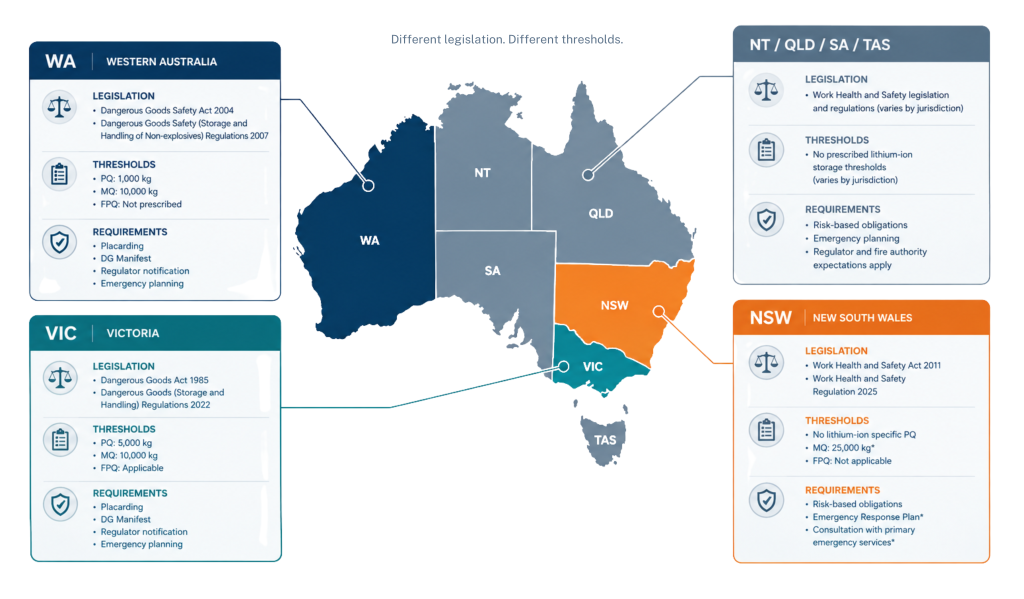
How state by state Lithium-ion battery storage regulations vary in AustraliaVictoria: the most prescriptive framework
Governed by the Dangerous Goods Act 1985 and the Dangerous Goods (Storage and Handling) Regulations 2022. Lithium-ion batteries are treated as Class 9 Dangerous Goods. Depending on quantity stored, businesses may need to display DG placards, maintain a DG Manifest, notify WorkSafe Victoria, assess fire protection requirements, and consult Fire Rescue Victoria (FRV) or the Country Fire Authority (CFA).
Western Australia: a similar model, without a prescribed FPQ
Governed by the Dangerous Goods Safety Act 2004 and the Dangerous Goods Safety (Storage and Handling of Non-explosives) Regulations 2007. Obligations mirror Victoria's, including placards, a DG Manifest, notification to WorkSafe WA and emergency planning, but WA does not prescribe a Fire Protection Quantity threshold.
New South Wales: a risk-based approach
Governed by the Work Health and Safety Act 2011 and Work Health and Safety Regulation 2025. Lithium-ion batteries are not assigned specific DG quantity thresholds under the Schedule 11 hazardous chemical framework. Businesses must instead identify hazards, assess fire and thermal-runaway risks, implement reasonably practicable controls and develop emergency response arrangements. Regulation 361 requires PCBUs to prepare an Emergency Response Plan and consult the primary emergency service organisation where relevant; businesses should also consider guidance from Fire and Rescue NSW (FRNSW).
QLD, SA, TAS, NT and ACT: harmonised WHS
These jurisdictions operate under harmonised WHS legislation broadly consistent with the NSW framework, and do not assign dedicated battery thresholds under Schedule 11. The same core obligations apply: hazard identification, risk assessment, reasonably practicable controls and emergency response procedures. Regulators, insurers, landlords and planning authorities may still expect risks to be demonstrably managed even without a prescribed threshold.
Compliance Obligations Once Thresholds Are Exceeded
As storage quantities increase, additional requirements commonly arise, particularly in Victoria and WA, though the specifics vary by jurisdiction:
- Placarding: required above the applicable PQ threshold, giving emergency responders critical hazard information during an incident.
- Safety Data Sheets and DG registers: current SDSs and an up-to-date register of on-site Dangerous Goods, covering hazards, storage requirements, emergency procedures and fire-fighting considerations, which regulators and insurers may request during inspections or incidents.
- Dangerous Goods Manifests: required above the applicable MQ threshold, detailing DG classifications, quantities, storage locations, site layout and emergency contacts for responders.
- Authority notification: certain jurisdictions require notifying the relevant regulator (e.g. WorkSafe Victoria, WorkSafe WA, DWER etc.) once thresholds are exceeded.
- Emergency planning: procedures should address thermal runaway, battery fires, toxic gas release, evacuation, isolation arrangements and emergency services engagement. In NSW, Regulation 361 may require an Emergency Response Plan and consultation with the primary emergency service organisation.
- Fire authority consultation: early engagement with FRV, CFA or FRNSW (as applicable) helps ensure storage arrangements, emergency access and fire protection systems meet authority expectations.
- Dangerous Goods Licence: In WA, a site licence is required once storage exceeds the manifest quantity and no exemption applies. Application requirements are set out in the Regulations, with supporting guidance on the LGIRS website.
Compliance Does Not Start at a Threshold
It's often assumed that obligations only apply once a prescribed quantity threshold is exceeded. Businesses actually have ongoing responsibilities to identify hazards, assess risks and implement appropriate controls regardless of storage quantity. Even where no battery-specific threshold applies, regulators, insurers, landlords and emergency services may still expect risks to be appropriately assessed and managed. Thresholds add administrative requirements, but they don't remove this broader obligation.
When Should Businesses Seek Specialist Advice?
Many businesses can manage lithium-ion battery storage through good internal practices and compliance with applicable requirements. Specialist Dangerous Goods or fire safety advice is worth considering when:
- Storage quantities are approaching or exceeding PQ, MQ or FPQ thresholds
- Multiple classes of Dangerous Goods are stored on site (e.g. batteries alongside flammable liquids, aerosols or gases)
- A new warehouse, distribution centre or storage area is being designed, so compliance can be addressed at the planning stage
- Storage quantities, battery types or facility layouts change significantly
- Regulators, fire authorities, landlords or insurers request evidence of compliance or risk assessments
- Planning approvals, development conditions or lease agreements reference Dangerous Goods storage requirements
Key Takeaways
- Lithium-ion battery storage regulations vary across Australia depending on the jurisdiction.
- Victoria and WA apply dedicated Dangerous Goods frameworks with prescribed thresholds that can trigger placarding, manifest and notification requirements.
- NSW and the other harmonised WHS jurisdictions rely primarily on risk-based obligations and emergency planning.
- Thresholds are not the only compliance trigger; hazard identification, risk assessment and controls apply regardless of quantity.
- Fire safety, emergency planning and risk management remain important for every facility storing lithium-ion batteries.
- Where uncertainty exists, specialist Dangerous Goods and fire safety advice can help avoid costly compliance issues.
Need Help Understanding Your Obligations?
Understanding which requirements apply to your facility can be challenging, particularly with large battery quantities, mixed Dangerous Goods inventories, insurer requirements or planning conditions involved.
Risk and Safety Solutions Melbourne (RSSM) assists businesses across Australia with lithium-ion battery storage compliance, Dangerous Goods assessments and fire safety studies. For project-specific advice, contact our team:
Phone: +61 (03) 9804 8571
Mobile: +61 4680 032 922
Email: info@riskandsafetysolutions.au
Website: www.riskandsafetysolutions.au
Frequently Asked Questions
Are lithium-ion batteries Dangerous Goods in Australia?
Yes, they are generally classified as Class 9 Dangerous Goods for transport and storage, though how storage is regulated differs between jurisdictions. Which is why lithium-ion battery storage regulations in Australia differ depending on where the facility is located
What quantity triggers placarding, and is an Emergency Response Plan required?
The Placard Quantity depends on the jurisdiction. Victoria applies 5,000 kg, for example, versus 1,000 kg in Western Australia. Separately, emergency planning requirements can arise under Dangerous Goods legislation, WHS legislation, planning approvals, insurer requirements or fire authority expectations, so most facilities storing meaningful quantities will need one in some form.
Do NSW and Queensland have lithium-ion-specific storage thresholds?
Not currently. Batteries are not assigned dedicated thresholds under the Schedule 11 hazardous chemical framework in either state, and businesses remain subject to WHS obligations and emergency planning requirements regardless.
References and Guidance Documents
FRNSW Position Statements on Lithium-Ion Batteries
Dangerous Goods Act 1985 (Victoria).
Dangerous Goods (Storage and Handling) Regulations 2022 (Victoria).
Dangerous Goods Safety Act 2004 (Western Australia).
Dangerous Goods Safety (Storage and Handling of Non-explosives) Regulations 2007 (Western Australia).
Work Health and Safety Act 2011 (NSW).
Work Health and Safety Regulation 2025 (NSW).
Safe Work Australia, Model Work Health and Safety Regulations.
Safe Work Australia, Managing Risks of Hazardous Chemicals in the Workplace (Code of Practice).
Fire and Rescue NSW (FRNSW), Lithium-Ion Batteries: Fire Safety Guidance.
WorkSafe Victoria, guidance material relating to the storage and handling of Class 9 Dangerous Goods.