

Management Plans Required for Hazardous Developments in Australian Jurisdiction
Large-scale developments involving Dangerous Goods (DG), hazardous materials, battery energy storage facility (BESS), waste recycling facilities and potentially offensive industries are subject to increasing scrutiny from planning authorities, regulators, and emergency services.
When a project involves hazardous materials or dangerous goods, regulatory authorities require specific safety management plans before granting final development approval. While early project work focuses on broad environmental licensing, these detailed safety plans are required to show the regulator exactly how the site will contain hazards and handle emergencies during operations.
For proponents, the challenge is not simply preparing individual plans, it is ensuring they are technically aligned, risk-informed, and consistent across regulatory frameworks.
Why Management Plans Matter in Hazardous Developments
Facilities handling Dangerous Goods (DG), or waste materials present complex risk profiles involving fire, explosion, or chemical release. Because of these inherent dangers, specialist management plans are a mandatory requirement for project approval.
From a regulatory perspective, these documents prove that a proponent has identified site-specific risks and has structured, documented controls in place before operations begin. Which greatly smoothens the approval process.
But these plans also need to be prepared to meet authority expectations. As authorities tend to assess projects based on hazards on the whole precincts or development rather than just individual hazards. In practice, incomplete or poorly integrated plans often result in:
- Requests for further information (RFI)
- Approval delays
- Additional consent conditions
- Redesign of site layout or fire strategy
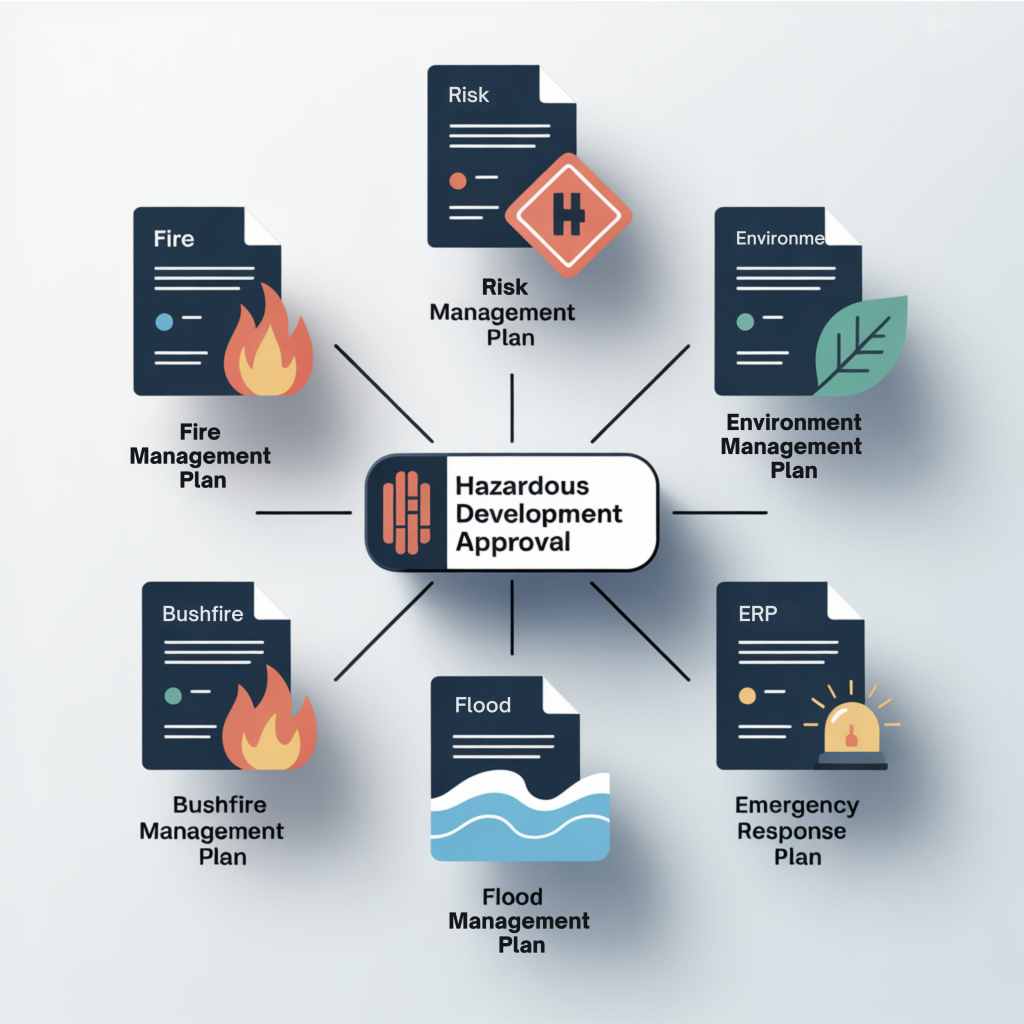
The Core Management Plans & Their Regulatory Triggers
The plans required for any given development depend on the nature and quantity of hazardous materials on site, its location relative to bushfire-prone land or flood overlays, applicable state legislation, and consent conditions issued at the approval stage.
The following table summarises the core management plans typically required for DG, BESS, waste recycling, and hazardous industry developments in Australia.
| Plan | What It Addresses | Typical Trigger |
| Fire Management Plan (FMP) | Fire risk prevention, detection, suppression systems, firewater supply, fire brigade access and intervention strategy | DG above placard/manifest quantities; fire protection thresholds; waste facility consent conditions |
| Risk Management Plan (RMP) | Hazard identification (HAZID/HAZOP), risk assessment, ALARP demonstration, control measures, monitoring and review | Scheduled Premises; MHF designation; consent conditions |
| Environmental Management Plan (EnvMP) | Air emissions, odour, contaminated runoff, waste handling, noise and vibration | Waste facility EPA licences; planning consent conditions |
| Bushfire Management Plan (BFMP) | BAL assessment, asset protection zones, vegetation management, bushfire emergency access and evacuation | Bushfire Prone Land overlay; RFS/CFA referral |
| Flood Management Plan | Flood inundation risk, impact on DG storage, containment of spilled or floating materials, critical infrastructure protection | Flood overlay; EPA licence conditions |
| Emergency Management Plan (EMP) | Governance structure, roles and responsibilities, communication protocols, resource requirements, integration with site management systems | DG regulations; WHS legislation; consent conditions |
| Emergency Response Plan (ERP) | Step-by-step emergency procedures for fire, explosion, hazardous material incidents, medical emergencies; coordination with emergency services | DG regulations; WHS legislation; consent conditions |
The FMP is typically developed alongside a Fire Safety Study (FSS) or Preliminary Hazard Analysis (PHA), with fire scenarios and protection system requirements informed by the hazard analysis outputs.
The EMP and ERP are closely related but distinct. The EMP is the governance framework — it defines how emergency management is structured across the organisation. The ERP is the operational document — it contains the step-by-step procedures staff follow during a specific incident. One does not replace the other; both are required.
In Victoria, facilities may be required to produce an Emergency Information Book (EIB) aligned with FRV guidelines. In NSW, an Emergency Services Information Package (ESIP) is required under HIPAP No. 1. These complement the ERP and are provided directly to fire services.
The specific plans required will vary depending on:
- The nature and quantity of hazardous materials on site
- The facility's location (proximity to sensitive receptors, bushfire-prone land, flood overlays)
- State or territory planning and environment legislation
- Consent conditions issued at the development approval stage
Integration Across Plans - How These Plans Work Together
A common challenge in hazardous developments is that these plans are often prepared in isolation.
However, regulators may assess for example:
- Whether fire scenarios in the FMP align with risk scenarios in the RMP
- Whether environmental controls in the EMP address firewater runoff from the FMP
- Whether emergency procedures in the ERP reflect credible hazards identified in the PHA
Gaps or inconsistencies between plans are a common cause of approval delays, additional information requests, and consent conditions. Developing these plans in a coordinated manner ideally with the same consultant across all documents ensures internal consistency and reduces the risk of regulatory friction.
Across multiple projects, recurring issues include:
| Issue | Typical Impact |
| Inconsistent hazard assumptions | Regulator queries and redesign |
| Misaligned fire and environmental strategies | Additional studies required |
| Inadequate emergency planning | Fire authority rejection |
| Lack of quantified risk basis | Delays in approval decisions |
Early coordination between hazard studies and management plans significantly reduces these risks.
The Role of Hazard Analysis
For many DG and waste developments, Preliminary Hazard Analysis (PHA) provides the technical foundation for all management plans. Without a structured hazard analysis, management plans risk becoming generic and non-defensible during regulatory review. RSSM PHAs evaluate DG thresholds, cascading failure pathways, radiant heat exposure, and explosion consequences informing separation design and fire strategy
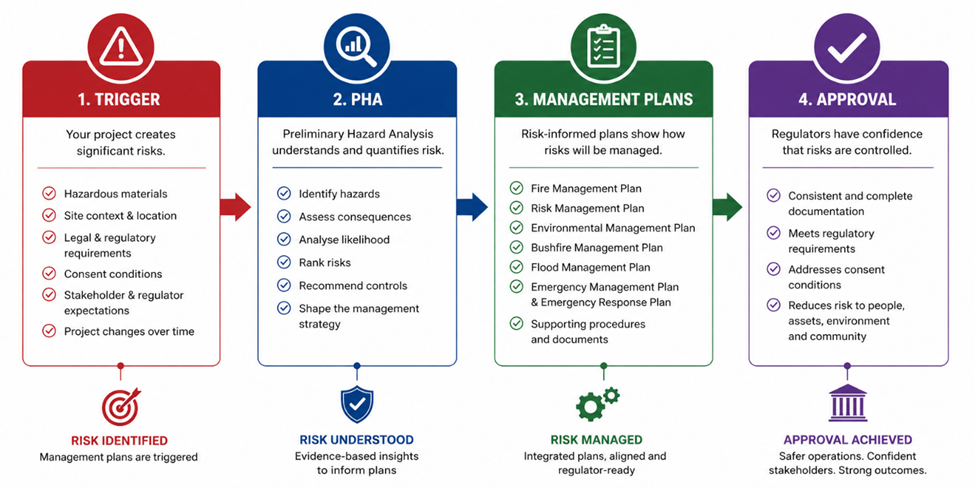
How RSSM Supports Hazardous Developments
Risk and Safety Solutions Melbourne (RSSM) supports clients by delivering integrated, regulator-aligned management planning across hazardous developments.
Our team delivers FMPs, RMPs, EMPs, ERPs, BFMPs, Flood Management Plans, EIBs, ESIPs, and environmental plans that are aligned with state planning frameworks, DG regulations, and fire authority expectations — developed as a coordinated suite to ensure consistency and support approval outcomes.
If you are at the planning application stage, early engagement with a specialist consultant significantly reduces the risk of costly redesigns, consent condition surprises, and regulatory delays.
RSSM is ready to assist in your development including the development of plans. Contact RSSM at info@riskandsafetysolutions.au or call +61 (03) 9804 8571 to discuss your project.
Conclusion
For hazardous developments involving Dangerous Goods and waste processing, management plans are no longer secondary documentation, they are central to demonstrating that risks are understood, controlled, and acceptable. Projects that adopt a structured and coordinated approach to management planning are better positioned to achieve timely approvals and operate safely. RSSM continues to support developers with development of such management plans.
Frequently Asked Questions (FAQ)
Q1: Are all these management plans required for every project?
Not necessarily. The required plans depend on project scale, location, regulatory triggers, and hazard profile. However, most DG and waste facilities will require multiple overlapping plans.
Q2: What is the most critical plan for approval?
There is no single “most important” plan. Approval decisions are typically based on how well all plans work together, supported by hazard analysis.
Q3: Can management plans be prepared independently?
While possible, it is not recommended. Plans prepared in isolation often lead to inconsistencies and regulatory challenges.
Q4: When should management planning start?
Ideally during the concept or early design phase. Late-stage planning often results in redesign and approval delays.
Q5: How do hazard studies relate to management plans?
Hazard studies such as PHA or QRA provide the technical basis that informs all management plans, ensuring they are risk-based and defensible.
Q6: Are all these management plans required for every project?
Not necessarily. The required plans depend on project scale, location, regulatory triggers, and hazard profile. However, most DG and waste facilities will require multiple overlapping plans.
Q7: What is the most critical plan for approval?
There is no single “most important” plan. Approval decisions are typically based on how well all plans work together, supported by hazard analysis.The EMP is the governance framework, it covers roles, responsibilities, communication protocols, and how emergency management is structured across the organisation. The ERP is the operational document, it contains the step-by-step procedures for staff to follow during a specific emergency scenario. Both are required for hazardous developments; one does not replace the other.
Q8: Do these plans need to be updated after approval?
Yes. Most management plans are living documents. Regulatory frameworks, site layouts, DG inventories, and operational procedures change over time. Many consent conditions specify review triggers. For example, following a significant incident, a change in DG quantities, or on a fixed periodic basis (commonly every 3-5 years).
References
Regulatory Guidelines and Advisory Papers
1. NSW Department of Planning, Industry and Environment. Hazardous Industry Planning Advisory Paper No. 1 – Emergency Planning. NSW Government, 2011. https://www.planning.nsw.gov.au/sites/default/files/2023-03/hazardous-industry-planning-advisory-paper-no-1-emergency-planning.pdf
2. NSW Department of Planning, Industry and Environment. Hazardous Industry Planning Advisory Paper No. 2 – Fire Safety Study Guidelines. NSW Government, 2011. https://www.planning.nsw.gov.au/sites/default/files/2023-03/hazardous-industry-planning-advisory-paper-no-2-fire-safety-study-guidelines.pdf
3. NSW Department of Planning, Industry and Environment. Hazardous Industry Planning Advisory Paper No. 6 – Hazard Analysis. NSW Government, 2011. https://www.planning.nsw.gov.au/sites/default/files/2023-03/hazardous-industry-planning-advisory-paper-no-6-hazard-analysis.pdf
4. NSW Rural Fire Service. Planning for Bush Fire Protection 2019. NSW RFS, 2019. https://www.rfs.nsw.gov.au/__data/assets/pdf_file/0005/174272/Planning-for-Bush-Fire-Protection-2019.pdf
5. Fire Rescue Victoria. Fire Safety Guideline GL-52 – The Development of Pre-Incident Plans for Major Hazard Facilities and Dangerous Goods Sites. FRV, 2024. https://www.frv.vic.gov.au/sites/default/files/2024-02/FRV-Fire-Safety-Guideline-GL-52-The-development-of-pre-incident-plans-for-major-hazard-facilities-and-dangerous-goods-sites.pdf
6. Fire Rescue Victoria. Fire Safety Guideline GL-54 – Fire Safety Study (FSS). FRV, 2024. https://www.frv.vic.gov.au/sites/default/files/2024-07/GL-54-Fire-Safety-Study-(Final-Version)-240724-FORMATTED.pdf
7. Fire Rescue Victoria. Fire Safety Guideline GL-55 – Battery Energy Storage Systems (BESS). FRV, 2025. https://www.frv.vic.gov.au/sites/default/files/2025-08/GL-55-Battery-Energy-Storage-Systems-v1.0.pdf
8. Country Fire Authority. Design Guidelines and Model Requirements: Renewable Energy Facilities (Version 4.4). CFA Specialist Risk and Fire Safety Unit, June 2025. https://www.cfa.vic.gov.au/plan-prepare/building-planning-regulations/renewable-energy-fire-safety
9. Standards Australia. AS 3745:2010 – Planning for Emergencies in Facilities (incorporating Amendments 1 and 2). Standards Australia, 2010. https://store.standards.org.au/product/as-3745-2010
10. International Organization for Standardization. ISO 31000:2018 – Risk Management: Guidelines. ISO, 2018. https://www.iso.org/standard/65694.html 11. Safe Work Australia. Model Work Health and Safety Regulations – Regulation 43: Emergency Plans. Safe Work Australia, 2024. https://www.safeworkaustralia.gov.au/doc/model-whs-regulations