

Emergency Information Book (EIB) and Emergency Services Information Package (ESIP)
When a fire truck pulls up to your site, firefighters have minutes — sometimes seconds — to assess the risks, locate hazards, and respond safely. They don't have time to guess what's stored inside, how to isolate power, or where dangerous goods are kept. That's why emergency site documentation like the Emergency Information Book (EIB) in Victoria and the Emergency Services Information Package (ESIP) in New South Wales exists.
Both tools serve the same critical purpose: giving first responders the essential information they need to act fast, stay safe, and protect your people, property, and business. This guide breaks down what each package includes, why it's required, and how you can get it right.
What is an Emergency Information Book (EIB)?
The EIB is Victoria's standardised emergency response document. It is a structured folder of information that helps Fire Rescue Victoria (FRV) understand your site before stepping through the door.
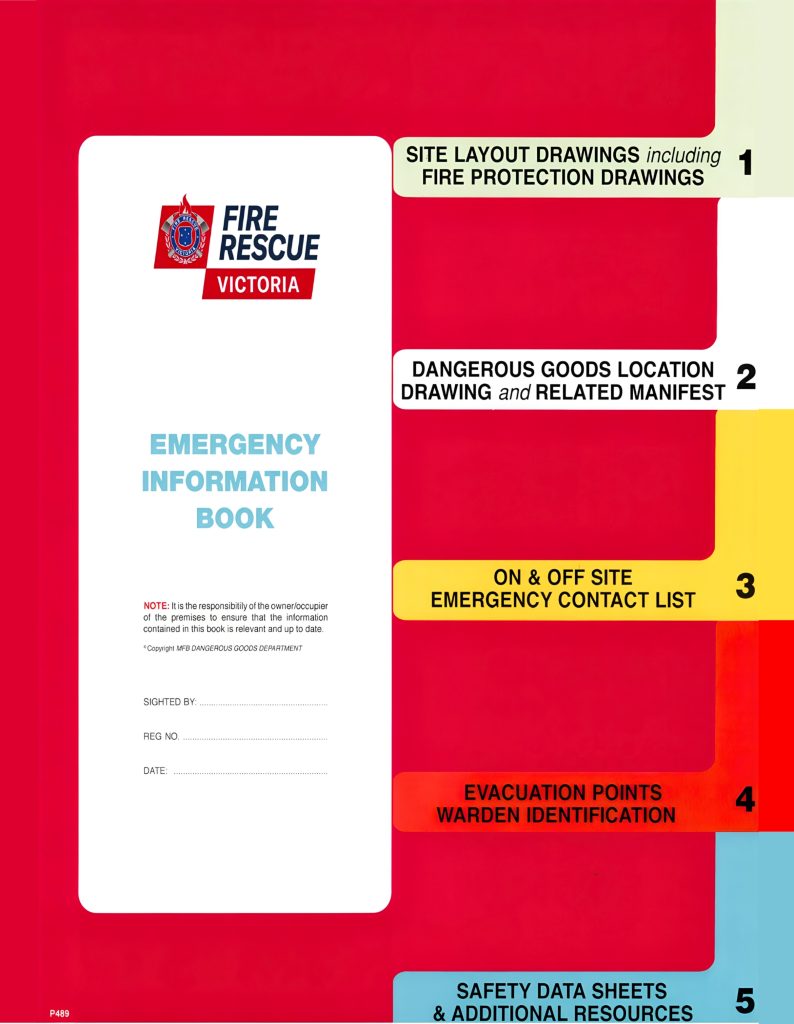
What is contained in EIB?
It must include the following sections:
Section 1
- Site Layout with internal racking and external access.
- Fire Protection Layout (which includes hydrants, sprinklers, extinguishers, booster)
Section 2
- Dangerous Goods Layout (a site layout indicating the DG storage zones using Globally Harmonized Symbols - GHS)
- Dangerous Goods Manifest (list of bulk and packaged DGs)
Section 3
- On-site Emergency Contact List (like, site manager, after-hours numbers, wardens)
- Off-Site Emergency Contact List
- Neighbors Emergency Contact List
Section 4
- Evacuation Points/Plan (a site layout clearly identifying the assembly area and evacuation route)
- Warden Identification (vest with luminous colors, like, red and yellow)
Section 5
- SDS folder stored physically
- SDS should also be available online
- Additional Resources
Where should you keep the EIB?
The file must be stored in a clearly marked red Emergency Information Container (EIC) at the site's main vehicle entrance. This container must be weatherproof, visible, and always accessible — firefighters are trained to look for it.
It must be:
- clearly visible
- weather-protected
- accessible to firefighters at all times
- labelled so staff can direct FRV to it immediately

Why FRV Requires it?
FRV uses the Emergency Information Book to:
- Gain immediate orientation during a response
- Understand where hazardous chemicals are stored
- Identify how to shut down utilities quickly
- Plan the safest firefighting strategy for everyone on site
Common Mistakes VIC Sites make
Too often, Emergency Information Books fail in moments of crisis because of avoidable oversights:
- Maps haven’t been updated after layout or racking changes
- Dangerous goods manifests are outdated or missing quantities
- Isolation points are either not labelled on plans or physically unmarked
- SDS records are years old, disorganised, or hard to find
- Emergency contact listed doesn’t answer after hours
- EIB is hidden in an office drawer instead of in the EIC
To learn more about EIB in details you may visit: Emergency Information Book Manual
What is an Emergency Services Information Package (ESIP)?
The ESIP is NSW’s equivalent — but with additional complexity and hazard-specific detail. Developed for Fire & Rescue NSW (FRNSW), it’s mandatory for any facility that handles large quantities of hazardous chemicals, operates a fire control room, or is classified as a Major Hazard Facility.
It is both a compliance document and a tactical emergency plan. It builds on the principles of the Emergency Information Book and adds layers of analysis that help firefighters make fast, safe, informed decisions.
What Makes an ESIP Different
It doesn’t just say what’s on site. It shows how those hazards behave under fire conditions and what to do about them. It includes:
- A site and operations summary
- Fire system layout: fire indicator panel, sprinklers, hydrants, pumps
- Dangerous Goods manifest and HazMat zones
- SDS index and locations
- Isolation points: electrical, gas, solar, ventilation
- Critical risk zones (lithium batteries, aerosols, oxidisers, LPG cages)
- Clearly labelled shutdown procedures with tactical notes
Tactical Fire Plans (TFPs) and Tactical Checklists (TCLs)
This is where the ESIP goes beyond traditional emergency documentation:
Tactical Fire Plans (TFPs) are large-scale laminated drawings (A3/A2) with:
- Colour-coded symbols (hydrants, isolation points, DG zones)
- Firefighting access points, appliance turning areas, booster inlet locations
- Risk overlays showing HazMat threats, drainage paths, and flame spread vectors
- Clear scale (1:200 recommended, 1:500 for very large sites)
Tactical Checklists (TCLs) provide written action steps:
- Who should isolate power or gas, and how
- What sequence to follow during a chemical release or battery fire
- Special considerations (e.g., avoid water on lithium batteries)
Together, these tools give responders a real-time, tactical understanding of your facility — essential for incidents involving chemical reactions, confined spaces, or mixed hazards
Common NSW Site Mistakes
- TFPs drawn at incorrect scale or missing critical symbols
- No risk-specific notes on battery storage or chemical reactivity
- TCLs too generic or copied from unrelated sites
- No mapping between DG manifest and physical locations
- Missing diagrams of ventilation systems and airflow
- Contacts and SDSs outdated, incomplete, or stored offline with no access
If your file isn’t up to standard, FRNSW may delay response or consider the site non-compliant — and that puts lives and assets at risk.
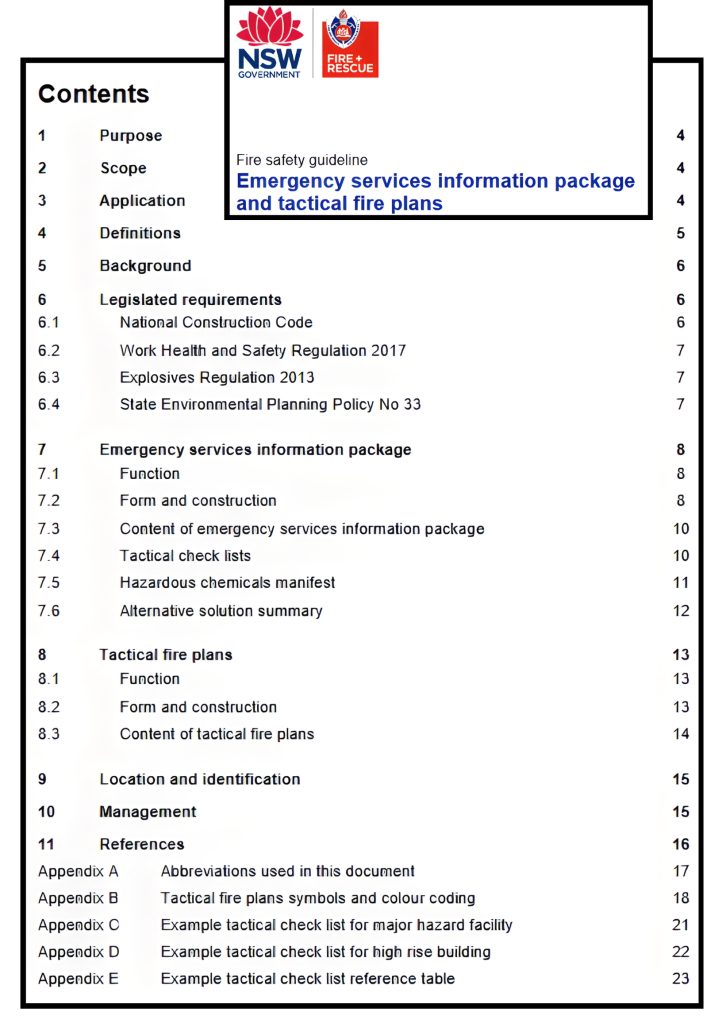
To learn more you may visit: Emergency services information package and tactical fire plans
What about other states?
You may ask, if these files are obligated in Victoria and NSW, then what about the other states? Well, its almost the same idea. Here are some examples:
South Australia: Uses an ESIP concept and expects a visible container for emergency info; SA guidance also includes labelling and access recommendations for the box. Industry sometimes calls similar boxes “Yellow Box” (colloquial). MFS
Western Australia: WA has a State Hazard Plan for HAZMAT; industry commonly uses a labelled “hazmat” or emergency manifest box to store SDS, site plans and manifests (colloquially “HazMat Box”). The state HAZMAT plan and DFES resources guide response arrangements. Western Australian Government
QLD / TAS / NT / ACT: All require emergency plans, manifests and SDS availability under WHS/dangerous-goods rules which they may not call EIB/ESIP, but the concept of a ready emergency info pack is the same.
How Risk & Safety Solutions Melbourne (RSSM) helps
We treat EIB/ESIP work as a site-readiness job, not a paperwork exercise:
- On-site walkthrough: we map hazards, appliance access and isolation points in one visit.
- DG manifest audit: check quantities, SDS, segregation, and update the manifest.
- Create firefighter-ready plans: clear A3 maps, colour-coded zones, and an “incident at a glance” first page.
- EIB/ESIP assembly: prepare folders or a locked emergency box with labelled dividers in FRV/FRNSW format. Fire Rescue Victoria
- Training & handover: brief the site manager and designated contacts so the package is usable under pressure.
If you’d like, we can do a short checklist review over a phone call and tell you whether your site is already compliant or what to prioritise.
Frequently Asked Questions (FAQs)
Is EIB or ESIP legally required?
Who is responsible for maintaining the EIB/ESIP?
How often should we update the information?
After DG quantity changes
Every time contact details change
AT LEAST every 6–12 months as a routine review
Where should we keep our EIB/ESIP?
Does a small warehouse need an EIB/ESIP?
Is an ESIP different from a DG Manifest?
Can we just download a template and fill it out?
What if firefighters can’t find our EIB/ESIP?
- It’s in a marked cabinet or box
- Staff know where it is
- The entry point is not blocked
- It’s labelled according to FRV/FRNSW expectations