
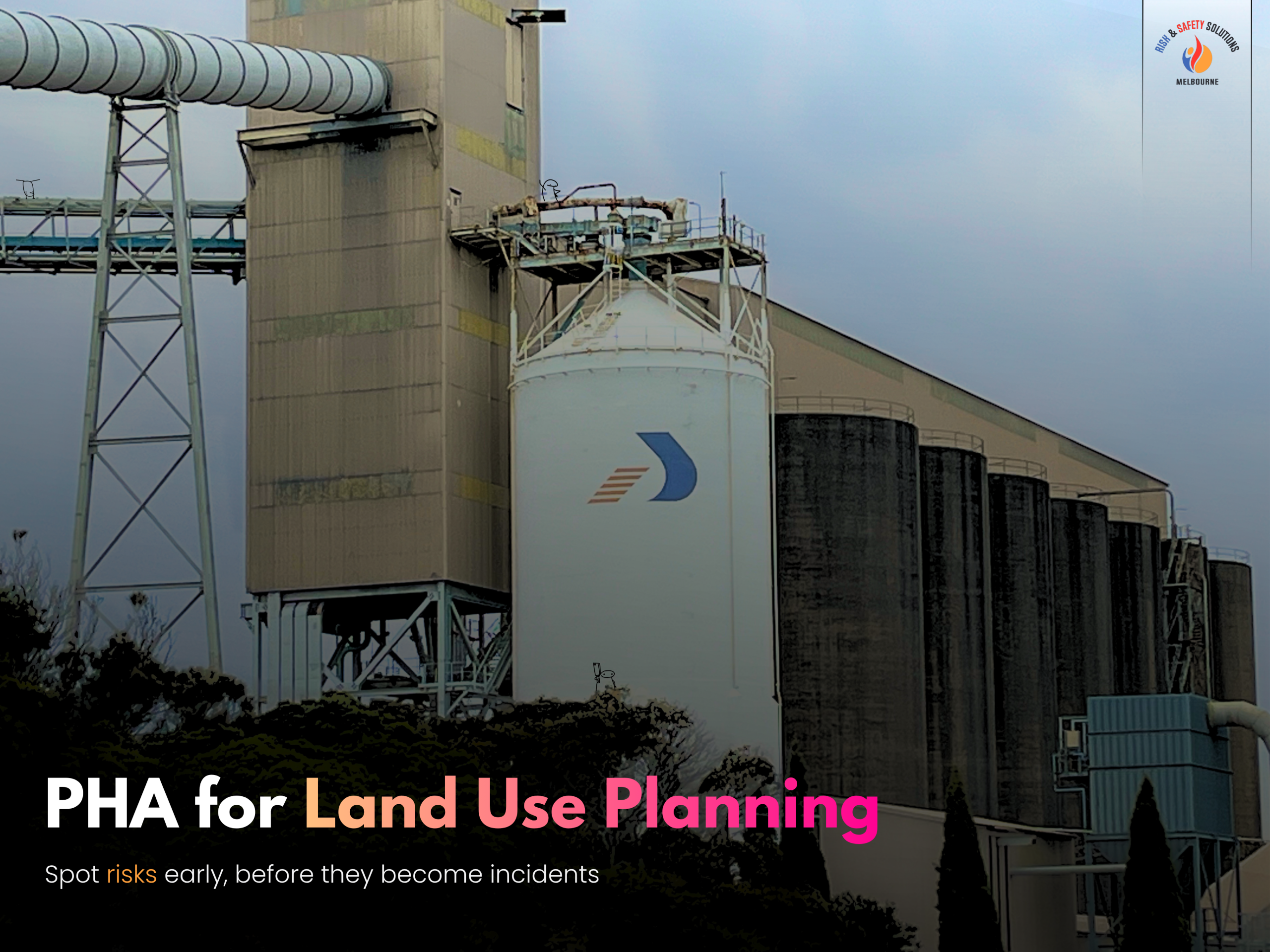
Preliminary Hazard Analysis (PHA) for Planning Decision
Planning a new industrial or hazardous facility involves more than assessing whether the Site can accommodate the proposed operations. It is also important to consider how the facility may interact with the surrounding area, particularly where nearby residents, businesses, schools, infrastructure or other sensitive land uses could be affected by a fire, explosion or hazardous release.
A Preliminary Hazard Analysis (PHA) provides a structured approach to identify potential hazards, assess their consequences and determine whether the associated risks can be appropriately managed. This is particularly relevant for developments such as data center, dangerous goods storage facilities, chemical facilities, Battery Energy Storage Systems (BESS), Major Hazard Facilities (MHFs), and waste and recycling facilities.
Depending on the type, scale and location of the development, a PHA may form an important part of the planning and approval process. It can help demonstrate that potential risks to surrounding areas have been considered and identify appropriate measures to support safe and compatible land use.
This blog covers preliminary hazard analysis (PHA) triggers, methodologies and regulatory exapectations.
What is Preliminary Hazard Analysis (PHA)?
A Preliminary Hazard Analysis (PHA) is a structured assessment used to identify hazards associated with a proposed development, examine credible incident scenarios, consider potential consequences and identify measures to control and mitigate risk within acceptable limit.
For land use planning, the assessment has a broader focus than routine workplace safety. It considers whether an onsite incident associated with the proposed facility could affect both onsite and offsite people, property or environment.
A typical PHA may consider the hazardous materials and inventories, processes and storage arrangements, credible loss-of-containment or fire and explosion scenarios, consequence distances, escalation pathways, existing and proposed safeguards, and the surrounding population and land uses.
Why is PHA Important for Land Use Planning?
Land use planning safety considers whether the proposed development is suitable for its location and whether its activities may affect surrounding areas. Modern facilities can involve hazards such as dangerous goods, lithium-ion batteries, pressurized gases and combustible materials, which may have consequences beyond the Site boundary.
A PHA considers credible fire, explosion, toxic and hazardous release scenarios, including potential effects on nearby residential areas, commercial properties, transport corridors and other sensitive receptors. It may also consider cumulative risks from nearby hazardous facilities and factors such as site access and emergency response.
By identifying hazards, assessing potential consequences and considering appropriate risk controls, a PHA provides a technical basis for concluding the suitability of a proposed development within its surrounding land-use context.
What Triggers a Preliminary Hazard Analysis (PHA)?
A PHA is generally initiated early in the project lifecycle during the land use planning or feasibility phase. Primary triggers include-
| Category | Trigger Type | Key Criteria |
| Regulatory & Planning | Hazards Screening (e.g. SEPP 33) | Exceeding chemical/dangerous goods threshold limits (e.g., NSW SEPP). |
| Consent Authorities | EIS, DA, or Planning Scheme Amendments requiring off-site safety demo. | |
| EPA Referrals | Proximity to sensitive environmental receptors or buffer requirements. | |
| Technical & Operational | Dangerous Goods | Storage/handling above manifest or screening threshold quantities. |
| High-Energy Storage | Integration of utility-scale BESS or hydrogen infrastructure. | |
| Spatial Proximity | Close proximity to sensitive land-use boundaries. |
When Should a PHA Be Undertaken?
A PHA is most useful when undertaken early in the project lifecycle, during site selection, feasibility, planning or concept design, so that its findings can influence the project before major design decisions are fixed.
For existing facilities, a PHA or further hazard assessment may also be appropriate when there is a significant change to the facility's hazardous inventory, operations, layout or surrounding land use.
How Is a Preliminary Hazard Analysis (PHA) Prepared?
A PHA applies a structured, multi-level risk assessment methodology. The level of analysis is proportionate to the nature, scale and location of the hazards and may progress from qualitative screening through semi-quantitative consequence assessment to a detailed Quantitative Risk Assessment (QRA).
The methodology is generally consistent with recognised guidance from the Center for Chemical Process Safety (CCPS), the UK Health and Safety Executive (HSE) and the NSW Hazardous Industry Planning Advisory Papers (HIPAPs), particularly HIPAP Nos. 4 and 6.
The assessment typically includes:
- Hazard identification (HAZID): Identify hazardous materials, inventories, processes, storage and handling activities, utilities, transport interfaces, operational hazards and credible external threats.
- Major accident scenario development: Develop a representative but sufficiently comprehensive range of credible scenarios, such as loss of containment, full-bore rupture, pool and tank fires, jet fires, flash fires, BLEVEs, vapour cloud or dust explosions, battery thermal runaway and toxic gas releases.
- Consequence analysis: Model the potential extent and severity of thermal radiation, explosion overpressure, flammable gas dispersion and toxic exposure. Results are compared against relevant impact criteria and mapped against site boundaries, occupied buildings, neighbouring facilities and sensitive land uses.
- Likelihood and risk screening: Assess scenario likelihood using qualitative or semi-quantitative methods, including risk matrices, failure data, event-tree analysis or Layer of Protection Analysis (LOPA), where appropriate. CCPS describes LOPA as a semi-quantitative method for assessing individual cause–consequence scenarios and the effectiveness of independent protection layers.
- Control effectiveness assessment: Evaluate preventive and mitigative safeguards, including process controls, shutdown and isolation systems, detection, ventilation, pressure relief, secondary containment, fire protection, separation distances and passive fire protection. Controls should only be credited where their effectiveness, independence, reliability and ongoing maintenance can be demonstrated.
- Quantitative Risk Assessment (QRA): Where screening identifies potentially significant off-site consequences, sensitive surrounding land uses, multiple interacting scenarios or uncertainty regarding risk acceptability, the assessment may progress to a QRA. A QRA combines scenario frequencies and consequence modelling to calculate individual and, where relevant, societal risk. The UK HSE also uses quantified risk assessment and consequence modelling to inform land-use planning decisions around major-hazard facilities.
- Land-use risk evaluation: Compare consequence contours and calculated risk levels with applicable planning criteria to determine whether the development is compatible with surrounding land uses and whether additional safeguards or design changes are required.
- Risk reduction and demonstration: Identify further reasonably practicable measures to eliminate hazards or reduce risks, document residual risk and demonstrate that the proposed controls achieve the applicable ALARP or SFARP standard.
The PHA is therefore not limited to a single qualitative risk matrix. It is an escalating assessment process in which the analytical effort increases with the potential severity, complexity and off-site implications of the identified hazards.
What Software Is Used for a PHA?
The software required depends on the assessment level and complexity of the hazards. Commonly used tools include:
- EFFECTS or PHAST: Consequence modelling of loss of containment, pool fires, jet fires, flash fires, fireballs, explosions and toxic or flammable gas dispersion.
- RISKCURVES or Safeti: QRA software used to combine consequence results with event frequencies, ignition probabilities, weather data and population distributions. Outputs may include individual-risk contours, societal-risk F–N curves and potential-loss-of-life estimates. PHAST is primarily a consequence-modelling tool, whereas Safeti incorporates consequence and quantitative risk modelling.
- Computational Fluid Dynamics (CFD): Advanced three-dimensional modelling may be required where congestion, confinement, complex terrain, buildings or ventilation significantly influence dispersion, fire or explosion behaviour. Examples include FLACS-CFD, FDS, KFX, ANSYS Fluent and OpenFOAM. FLACS can model hazardous-material dispersion, fires and explosions, while FDS is primarily designed for smoke, heat and fire-driven flows.
- GIS and mapping software: Used to map consequence and risk contours against site boundaries, neighbouring facilities, transport corridors, population areas and sensitive land uses.
No particular software package is universally mandatory. The selected model should be appropriate for the hazardous material, release mechanism and physical effects being assessed. The PHA should clearly document:
- software name and version;
- model selection and limitations;
- input data and assumptions;
- weather and surface conditions;
- release and ignition parameters;
- validation basis;
- sensitivity analysis; and
- interpretation of the modelling results.
Standard integral models such as EFFECTS or PHAST are generally appropriate for initial consequence assessment. A full QRA may require RISKCURVES or Safeti, while CFD should be considered where simplified models cannot adequately represent complex dispersion, fire or explosion behaviour.
Land Use Planning Safety Criteria
Land-use planning safety criteria provide a consistent basis for regulators, proponents, design teams, emergency services, local councils and planning authorities to make informed decisions about hazardous developments and surrounding land uses.
In accordance with HIPAP No. 4—Risk Criteria for Land Use Safety Planning, the assessment considers individual and societal risk, injury, property damage, accident propagation and environmental impacts. Relevant fire, explosion and toxic-release risks are assessed against the applicable criteria for residential, commercial, industrial and sensitive land uses.
The assessment also considers whether avoidable risks have been eliminated, risks have been reduced as far as practicable, and significant incident effects are contained within the site boundary wherever possible.
How are Different Levels of Risk Assessment Applied in a PHA?
Not every PHA requires the same level of analysis. The level of assessment should be proportionate to the hazards, potential consequences, project stage and regulatory requirements.
| Assessment Level | Methodology & Methodology Approach | Application & Suitability |
| Qualitative Assessment | Uses structured professional judgement to systematically identify hazards, credible accident scenarios, potential consequences, and proposed risk controls. | Ideal when hazards and risk controls can be adequately understood and demonstrated without detailed numerical modeling. |
| Semi-Quantitative Assessment | Introduces numerical or consequence-based information (such as thermal radiation or overpressure impact distances) to provide structured differentiation. | Suitable when greater clarity between scenarios and risk levels is required beyond expert opinion alone. |
| Quantitative Risk Assessment (QRA) | Provides detailed numerical modeling of event frequencies, physical consequence modeling, and individual/societal risk calculations. | Appropriate for higher-risk developments, complex multi-hazard facilities, or where planning authorities mandate explicit risk criteria demonstration. |
Relationship Between SEPP 33 Screening and PHA
In NSW, SEPP 33 screening can form an early part of the assessment of potentially hazardous and offensive development. The screening process can help determine whether a proposal warrants further consideration of hazardous risks.
Where further assessment is required, a PHA can provide a more detailed examination of hazards, credible incident scenarios, consequences and risk controls. The exact relationship and submission requirements depend on the planning pathway and the characteristics of the proposal.
In practical terms, the process may be viewed as an initial screening followed, where required, by more detailed hazard and risk assessment to support land use planning.
Individual Risk and Cumulative / Societal Risk
Risk can be considered from different perspectives. Individual risk considers the risk to a person at a particular location arising from incidents associated with the facility.
Cumulative or societal risk considers the potential effect of major incidents on groups of people. This can become particularly relevant where a hazardous facility is located near areas with significant populations or multiple surrounding land uses.
The appropriate risk measures and criteria depend on the applicable planning framework and the characteristics of the development.
Application of PHA Across Key Industry Sectors
1. Battery Energy Storage Systems (BESS)
Assesses thermal runaway, fire propagation, toxic and flammable off-gas releases, explosion hazards and impacts on neighbouring land uses. Relevant fire-service guidance, such as FRV GL-55, may also inform the assessment.
2. Dangerous Goods Warehouses
Evaluates fires, explosions, toxic releases, chemical incompatibilities, spills and contaminated firewater to determine appropriate separation, containment and emergency controls.
3. Major Hazard Facilities (MHFs)
Supports the Safety Case and associated safety assessment by identifying major incident scenarios and evaluating risks from toxic, flammable and explosive materials.
4. Waste and Recycling Facilities
Assesses stockpile fires, hidden hazardous materials, lithium-ion batteries, gas cylinders, toxic smoke dispersion, fire propagation and contaminated firewater runoff.
5. Data Centres
Assesses hazards associated with bulk diesel storage, generators, transformers, lithium-ion battery systems and cooling chemicals. This includes fire, explosion, toxic off-gas, fuel spills, generator emissions and off-site impacts, with consideration of FRV Guideline GL-53—Data Centre Design Guideline where applicable.
How can a PHA be used to inform Site Layout and Land Use Planning?
PHA findings can be used to inform practical planning and design decisions. Depending on the project, these may include site layout, storage quantities, separation distances, hazardous material segregation, fire protection, emergency access and other risk controls.
The assessment can also identify whether surrounding land uses require additional consideration and whether further consequence or quantitative risk analysis is warranted.
Using PHA in this way allows potential risk issues to be considered while the project is still being developed, rather than treating risk assessment only as a final approval exercise.
Authority Expectations Across Australia and the USA
Regulatory expectations vary by jurisdiction; however, planning authorities, safety regulators, environmental agencies and emergency services generally expect major hazards to be identified early and supported by proportionate consequence or risk analysis.
Regulatory Guidelines For Preliminary Hazard Analysis:
- New South Wales: Planning authorities apply the HIPAP framework, particularly HIPAP Nos. 4 and 6. FRNSW reviews fire scenarios, emergency access, firefighting systems and responder safety.
- Victoria: DTP, EPA Victoria, WorkSafe Victoria, FRV and local councils focus on land-use compatibility, separation distances, environmental impacts, emergency response and, for applicable MHFs, Safety Case requirements. FRV Guidelines GL-53 and GL-55 may apply to data centres and BESS developments.
- Queensland: Planning authorities, safety and environmental regulators, Queensland Fire Department and councils consider hazardous chemical risks, off-site impacts, emergency access and firefighting provisions.
- Western Australia: LGIRS, DWER, DFES and local governments assess dangerous-goods compliance, environmental consequences, separation distances, emergency response and licensing requirements.
- South Australia, Tasmania, the ACT and Northern Territory: Relevant planning, safety, environmental and fire authorities apply jurisdiction-specific requirements, with emphasis on early hazard identification, off-site consequences and emergency-service consultation.
- United States: Requirements depend on federal, state and local jurisdiction. OSHA may require a Process Hazard Analysis under its Process Safety Management standard, while the US EPA Risk Management Program requires applicable facilities to assess accidental-release scenarios. Local Authorities Having Jurisdiction and fire marshals may apply the International Fire Code, NFPA standards and state-specific planning requirements.
Early engagement with the relevant authorities helps confirm the required assessment level, modelling criteria, emergency-response provisions and approval pathway.
Current Trends in PHA for Land Use Planning
Risk-based assessment is becoming increasingly important for developments involving emerging technologies, large hazardous inventories and complex major-incident hazards.
A number of recent hazardous-industry development applications—including data centres—have been delayed, remained under assessment or faced rejection because the submitted PHA did not adequately demonstrate compliance with applicable hazard-analysis and land-use risk criteria.
This highlights the importance of preparing a site-specific and technically defensible PHA early in the project. Planning authorities, safety regulators and emergency services increasingly expect credible scenario development, validated consequence modelling, QRA where required, and clear demonstration of risk reduction.
This trend is also reflected in Victorian fire-safety guidance, including FRV GL-55 for BESS and the consultation draft of FRV GL-53 for data centres. Requirements remain specific to each project and jurisdiction.
Where to Seek further assistance?
Risk and Safety Solutions Melbourne (RSSM) provides specialist risk engineering and fire safety consulting services for hazardous and complex developments across Australia.
With over 100 PHA studies completed for land use planning, RSSM has extensive experience across data centers, dangerous goods facilities, MHFs, BESS, waste and recycling facilities, and other hazardous industrial developments.
RSSM can support projects from early planning and screening through to hazard analysis, consequence assessment and risk evaluation. Our approach is tailored to the applicable regulatory framework and relevant planning and emergency authority requirements, including HIPAP 4, 6 and FRV GL-53 & 55, where applicable.
Reference
- HIPAP No. 2—Fire Safety Study Guidelines
- Hazardous Industry Planning Advisory Paper No. 4 (HIPAP No. 4) – Risk Criteria for Land Use Safety Planning.
- Hazardous Industry Planning Advisory Paper No. 6 (HIPAP No. 6) – Guidelines for Hazard Analysis.
- FRV GL-52—The Development of Pre-Incident Plans for Major Hazard Facilities and Dangerous Goods Sites
- Fire Rescue Victoria (FRV) Guideline GL-53 – Data Centre Design Guidance
- FRV GL-54—Fire Safety Study
- Fire Rescue Victoria (FRV) Guideline GL-55 –battery energy storage facilities (BESS).
- Heads of EPAs Australia and New Zealand, National Guideline for the Safe Management of End-of-Life Lithium-ion Batteries, 2026.
- FRNSW Position Statement—Emergency Plan Requirements at Sites Having Lithium Batteries, Version 01, December 2024.
- FRNSW Position Statement—Fire Safety Study Process, updated September 2024.
- FRNSW Position Statement—Electric Vehicles and EV Charging Equipment, updated August 2026.
- FRNSW Fire Safety Guideline—Emergency Services Information Package and Tactical Fire Plans, March 2023.
- FRNSW Fire Safety Guideline—Fire Safety in Waste Facilities, February 2020.
- FRNSW Fire Safety Guideline—Access for Fire Brigade Vehicles and Firefighters, November 2020.
- State Environmental Planning Policy (Resilience and Hazards) 2021, Chapter 3—Hazardous and Offensive Development
- NSW Department of Planning, Applying SEPP 33: Hazardous and Offensive Development Application Guidelines
- NSW Department of Planning, Multi-Level Risk Assessment Guidelines