
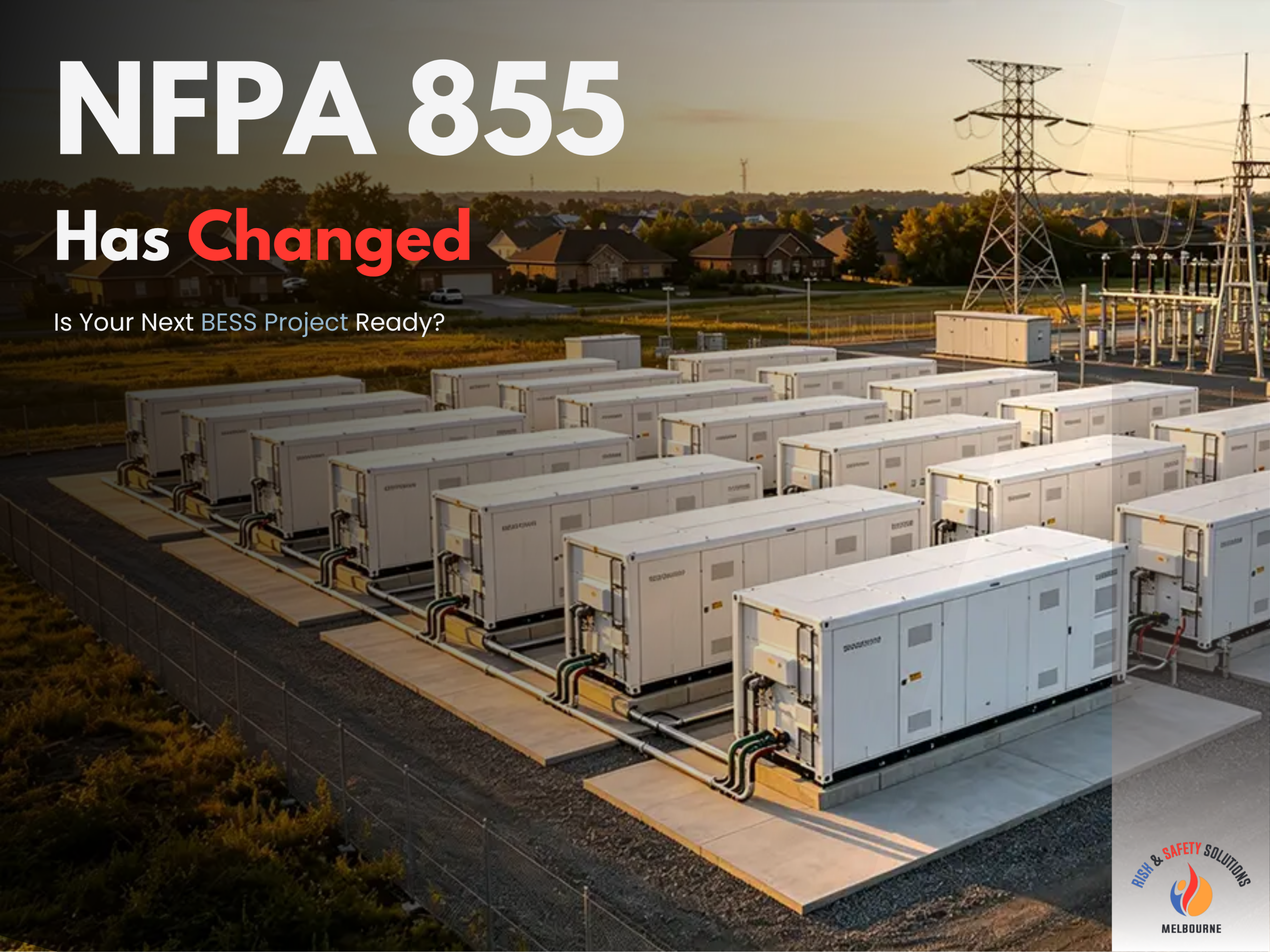
NFPA 855 (2026 Edition): Key Changes for Battery Energy Storage System (BESS) Projects
Battery Energy Storage Systems (BESS) continue to grow rapidly across utility, commercial, industrial, and critical infrastructure sectors. As project sizes increase and lithium-ion battery technology evolves, regulators and fire authorities are placing greater emphasis on fire safety, emergency response capability, and hazard mitigation.
The release of the 2026 edition of NFPA 855 – Standard for the Installation of Stationary Energy Storage Systems introduces several important updates aimed at improving the safety of energy storage installations and clarifying expectations for designers, operators, and regulators.
Although NFPA 855 is a United States standard, it is increasingly referenced globally by developers, insurers, equipment suppliers, and risk consultants when designing and BESS systems.
This article provides an overview of the key changes introduced in NFPA 855:2026 and discusses their potential implications for project development, fire safety studies, and risk assessments.
More battery chemistries explicitly covered
One of the notable changes in the 2026 edition is the expansion of technologies covered under the standard. Additional battery technologies and energy storage configurations have been incorporated. Emerging technologies including iron-air, lithium metal, nickel-hydrogen, sodium sulphur, and zinc-air are now listed by name with their own thresholds. The standard has also introduced dedicated requirements for flow batteries and energy storage systems installed on barges and vessels.
This reflects the industry's transition away from a predominantly lithium-ion focus toward a broader range of energy storage technologies.
For developers and designers, expanding technology coverage means a wider range of projects may now fall within the scope of NFPA 855 requirements. Early identification of applicable standards can help avoid redesigns during permitting and approval stages.
Greater Emphasis on Hazard Mitigation Analysis
This is the most operationally significant change in the 2026 edition. This edition places increased emphasis on Hazard Mitigation Analysis (HMA) and risk-informed design approaches, continuing the shift away from prescriptive compliance alone and toward demonstrating that identified hazards have been adequately assessed and mitigated. The 2026 edition also expands Annex G, providing more structured guidance on hazard identification, mitigation measures, and documenting engineering assumptions to support these risk-informed assessments. HMA is now the default for virtually all BESS installations within the scope.
Hazard Mitigation Analysis may consider:
- Thermal runaway propagation
- Flammable gas generation
- Explosion potential
- Fire spread between units
- Impacts on adjacent assets
- Emergency response effectiveness
Many of these assessments align closely with studies already undertaken for BESS developments, including:
- Preliminary Hazard Analysis (PHA)
- Fire Safety Study (FSS)
- Consequence Modelling
- Quantitative Risk Assessment (QRA)
As battery installations continue to increase in scale, developers will need to demonstrate compliance through engineering justification, fire testing, and documented risk assessments, rather than prescriptive requirements alone
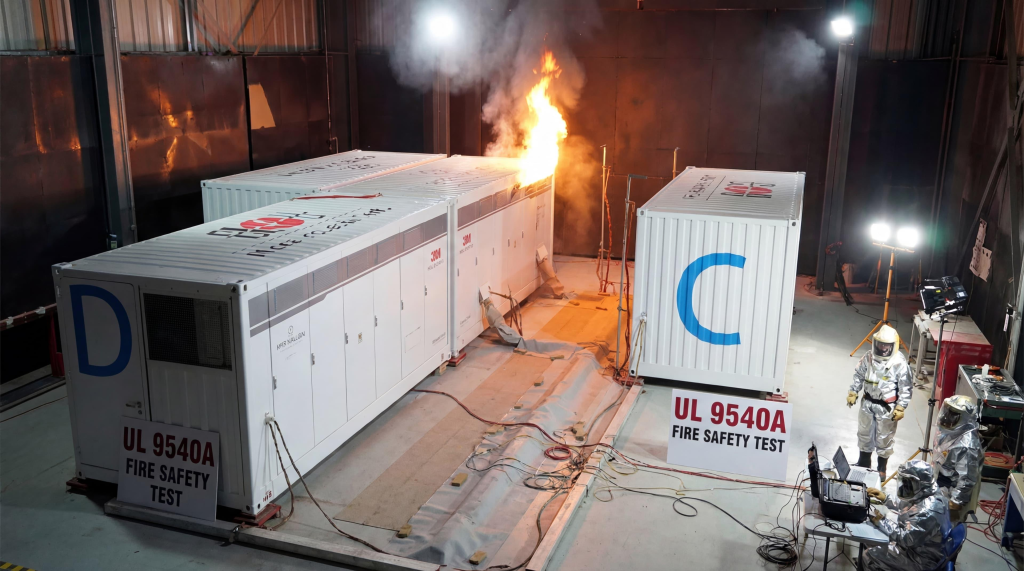
Fire testing: Large-scale fire testing now required alongside UL 9540A
UL 9540A evaluates thermal runaway propagation at cell, module, unit, and installation levels, but can conclude early if a given level demonstrates no propagation. The 2026 edition strengthens expectations regarding fire testing data used to support system design, separation distances, fire protection strategies, and emergency planning.
Fire testing results increasingly influence:
- Separation distance justification
- Thermal radiation assessment
- Explosion hazard analysis
- Emergency response planning
- Fire brigade intervention strategies
For project proponents, robust test data can significantly improve the defensibility of fire safety assessments submitted to regulators and fire authorities.
Updated Definitions and Competency Expectations for registered design professional
The 2026 edition revises the Qualified Person definition to require skills, knowledge, and training specifically related to BESS systems. This edition brings additional definitions and clarifies several existing terms to reduce ambiguity.
Also specifying that the risk assessment design process must be directed by a registered design professional with demonstrated experience in fire protection engineering and ESS risk assessment. For project teams, this means the person leading the HMA or fire risk assessment needs documented ESS credentials, not just general engineering qualifications.
Emergency Power Supply System Requirements
The 2026 edition introduces a dedicated section addressing Emergency Power Supply Systems (EPSS) and Stored Emergency Power Supply Systems (SEPSS). Critical safety functions are expected to maintain reliable power during emergency situations in accordance with recognised standards.
For large BESS installations, maintaining operation of critical systems during an incident may be essential for:
- Gas detection systems
- Monitoring systems
- Fire alarm systems
- Communication systems
- Emergency lighting
- Ventilation systems
Designers may need to demonstrate that critical safety functions remain available during abnormal operating conditions.
Emergency response plans: Increased Expectations
The standard continues strengthening requirements around emergency planning and emergency response coordination.
Emergency planning is no longer viewed as a standalone operational document. Instead, it is increasingly integrated with system design, fire testing outcomes, hazard analysis, and fire service engagement.
The 2026 edition adds three requirements that were absent before:
- Annual review of the emergency operations plan
- Annual refresher training for relevant personnel
- Formal notification to emergency responders of training dates and locations
These updates also reinforce early engagement with the Authority Having Jurisdiction (AHJ), such as FRV, FRNSW, CFA, or other relevant approval authorities in Australia.
Here is a snapshot of key changes in 2026 edition from the 2023 edition:
| Area | NFPA 855: 2023 Edition | NFPA 855: 2026 Edition |
| Battery chemistries covered | Core established chemistries; conservative threshold for "other" | Expanded list with chemistry-specific thresholds including iron-air, lithium metal, sodium sulfur, zinc-air, and others |
| Hazard Mitigation Analysis (HMA) | Required only where maximum stored energy thresholds are exceeded | Default requirement for virtually all ESS installations |
| Qualified Person definition | Skills and knowledge related to electrical equipment | Skills and knowledge specific to ESS; includes hazard mitigation |
| Risk assessment oversight | Referred to "parties" in Annex G | Registered design professional with ESS experience required |
| Emergency response plan | Periodic review | Annual review, annual refresher training, responder notification |
| Fire suppression structure | Separate NFPA 13 and "alternate" sections | Consolidated into a single automatic fire control section |
| Emergency power supply | Not addressed | New Section 4.10 requires EPSS/SEPSS for critical safety systems |
| Fire and explosion testing | UL 9540A | UL 9540A plus mandatory large-scale fire testing (LSFT) |
| TRPP systems | Not addressed | New Section 9.7.6.6 introduces TRPP system requirements |
| Lithium battery detection | Air-aspirating or radiant-energy detection | Smoke detection, thermal-image detection, or radiant-energy detection |
What Do These Changes Mean for Australian BESS Projects?
Although NFPA 855 is not directly adopted within Australian legislation, many of its principles influence Fire Safety Studies (FSS), Preliminary Hazard Analyses (PHA), consequence modelling, BESS design assessments, insurer reviews, and consultations with fire authorities.
For developers, these changes are likely to increase expectations for early hazard studies, regulator engagement, fire testing evidence, and documented engineering justification throughout the project approval process. This direction is already reflected in Australia. For example, Fire and Rescue NSW's (FRNSW) recent position statement aligns with NFPA 855:2026 by emphasising representative large-scale fire testing to support sprinkler system design and separation distances for larger ESS installations. Several themes emerging from NFPA 855:2026 closely mirror current expectations from Australian stakeholders.
How RSSM Supports BESS Projects
Risk and Safety Solutions Melbourne (RSSM) has delivered fire safety studies, preliminary hazard analyses, and emergency response plans for BESS projects across Australia — including utility-scale facilities in NSW, VIC, SA, and WA — as well as international projects in Saudi Arabia and Singapore.
Our team is experienced in Australian regulatory frameworks, including AS/NZS 5139, FRV GL-55, FRNSW guidance and AFAC guidance, as well as internationally recognised standards such as NFPA 855.
RSSM provides:
- Preliminary Hazard Analysis (PHA)
- Fire Safety Study (FSS)
- Fire Risk Assessment (FRA)
- Hazard Mitigation Analysis (HMA)
- Emergency Plans (e.g., Emergency Response Plan, Fire Management Plan, Emergency Management Plan etc.)
- Emergency Services Information Package (ESIP) and Emergency Information Book (EIB)
- Consequence and explosion modelling
- Dangerous Goods assessments and compliance
If you are planning a BESS project or would like to discuss how the latest NFPA 855 requirements may apply to your development, contact our team.
Phone: +61 (03) 9804 8571
Mobile: +61 4680 032 922
Email: info@riskandsafetysolutions.au
Website: www.riskandsafetysolutions.au
Conclusion
The 2026 edition of NFPA 855 reinforces the industry's shift toward performance-based, risk-informed approaches for Battery Energy Storage System safety.
While many changes focus on clarification and improved consistency, the overall direction is clear: greater emphasis on hazard mitigation, large-scale fire testing, emergency preparedness, and qualified technical assessment.
As these principles continue to influence industry practice, they are expected to shape project design, approval pathways, and fire safety expectations well beyond North America.
FAQ
Q1. Is NFPA 855 mandatory in Australia?
No. NFPA 855 is a United States standard. However, many of its principles are referenced by project developers, insurers, equipment manufacturers, and consultants when assessing BESS projects.
Q2. What is the most significant change in the 2026 edition?
The increased focus on hazard mitigation analysis and large-scale fire testing is widely regarded as one of the most influential developments in the new edition.
Q3. How does NFPA 855 relate to UL 9540A?
UL 9540A provides a fire testing methodology for evaluating thermal runaway and fire propagation behaviour. NFPA 855 uses this testing data to support installation and safety requirements.
Q4. How do these changes affect Fire Safety Studies (FSS)?
The changes reinforce the importance of consequence analysis, fire testing evidence, emergency response planning, and hazard-based assessment methodologies commonly used within Fire Safety Studies.
Q5. Why are fire authorities increasingly focused on emergency planning?
Large-scale BESS installations present unique hazards including thermal runaway, toxic gas release, and prolonged fire events. Effective emergency planning helps ensure responder safety and coordinated incident management.
References and Guidance Documents
- NFPA 855: Standard for the Installation of Stationary Energy Storage Systems, 2023 and 2026 Editions
- NFPA 72: National Fire Alarm and Signaling Code
- NFPA 110: Standard for Emergency and Standby Power Systems
- NFPA 111: Standard on Stored Electrical Energy Emergency and Standby Power Systems
- UL 9540A: Test Method for Evaluating Thermal Runaway Fire Propagation in Battery Energy Storage Systems
- UL 2684: Video and Thermal Image Detectors for Fire Alarm Systems
- ASME B31.1 / B31.3: Power Piping / Process Piping
- AS/NZS 5139: Electrical installations — Safety of battery systems for use with power conversion equipment
- Fire Rescue Victoria Guideline GL-55: Battery Energy Storage Systems (BESS)
- AFAC: Large-Scale Lithium-Ion Battery Energy Storage System Incident Response Guideline